I read an excellent article regarding the incredible statistic that only 4% of staff feel that performance reviews are useful here, and it really made me think. Why do we stick to formats that don’t produce results? A set and forget mindset is never going to create real change or development with measurable results, so let’s talk about how to do it differently. Let’s talk about how to turn annual reviews into a constant and continuous process that involves supporting and guiding staff to develop themselves in ways that benefit the business and allow employees to move further along in their chosen career path. If employee engagement is a problem, then let’s find new ways to get employees to engage. To that end, I produced this video with the help of an awesome online program from biteable.com, so I want to shout out to those guys for making a fantastic product, and encourage others to try it out. The findings and numbers in the video come from the article above about the survey run by Bamboo HR. I’ve enabled the option to download and share the video, and if you choose to do so, I would appreciate it if you linked back to this blog post because it did take effort to get it together. Thank you!
Tag Archives: training and development
Infographic: Gamification Increases Engagement and Learner Retention
With ever shortening attention spans and the constant demands on learners, it can be difficult to reach your audience. The principles of Gamification create an environment where learners want to interact, and where they can practice ways of improving daily tasks in a safe and simulated environment, increasing their ability to retain and utilise new skills and information. Gamification has the added benefit of being enjoyable, recharging batteries and energising participants; three key ingredients to making a happier, more engaged learner!
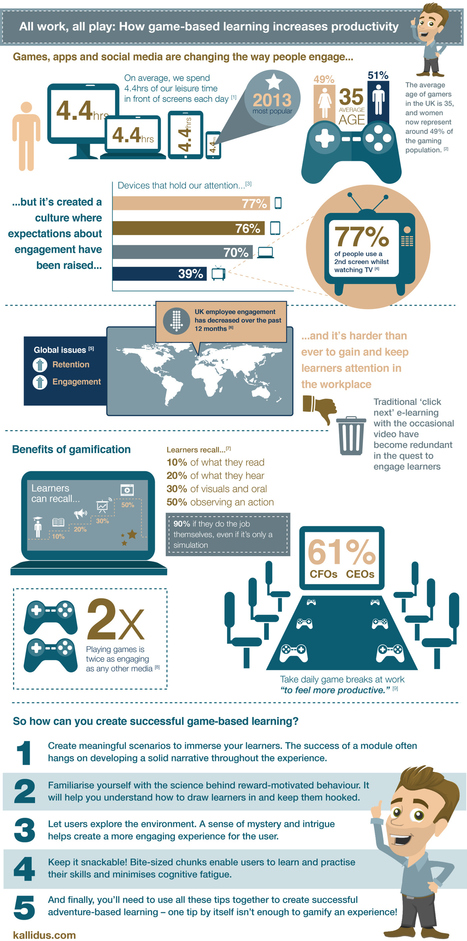
Increased engagement and learner retention are the names of the game
Have you implemented Gamification into your L&D? What was the result?
Infographic: Millennials and Social Learning
Social Learning and Millennials seem to go hand in hand. The focus on social media, communication and gamification tick all the generational stereotypes when L&D professionals try to appeal to the increasing numbers of Millennials and Post-Millennials joining the workforce. The key to success with Social Learning is to ensure that it is created on a level playing field where everyone’s expertise and ideas are valued; the tech-savvy youth of today know when they are being talked down to and when appeals for their participation lack authenticity. Remember, Millennials may have been raised in a technology obsessed world, but they are not a uniform group, no generation is, meaning that those entering the workforce in need of development need to be treated as individuals with individual development requirements and unique skill gaps. Social Learning is a highly beneficial way to identify those needs, and create a community around bridging the gaps.
For more information on Social Learning and how to get started, you can read my previous blog post here.

Social Learning and Millennials appear to be a match made in heaven!

Video: What is Gamification?
Currently one of the hottest ideas in L&D is adapting the principles of gamification to increase engagement and participation in Learning and Development opportunities. By introducing positive and enjoyable aspects of game play, facilitators and instructional designers are finding fresh ways to inject elements like competition, ‘leveling up’, quests and rewards, as a means of enhancing educational resources, increasing learner retention, and boosting engagement and participation. This video is an excellent general talking point around the positives and pitfalls of gameification and what it’s all about.
Is your organisation using gameification? What successes have you had?
Infographic: 5 Basic Learning Principles Every L&D Professional Needs To Know
There are basics that everyone needs to have in the back of their mind before they design or deliver any learning and development resources. Without engagement, repetition and a real understanding of how the skills and knowledge provided can benefit the trainee, learning outcomes will be compromised and retention is not a given. Ensure that you don’t overlook the basics before you move on to the more complex aspects of creating best practice training materials.

The basics all L&D professionals should remember when creating content and training

There are No Financial Barriers to Making an Effective Training Video
The biggest mental barrier to creating videos as learning and development resources is the perceived need to invest excessive time and money into unfamiliar and highly technical equipment and software to produce a premium product. Videos can be hugely expensive, and creating a micro-learning gallery of videos can be perceived to be well beyond the reach of smaller organisations. Costs incurred in instructional design, filming, editing and final production values make companies that are dipping their toes in the online learning environment very reluctant to move in any direction where ROI can be complicated to calculate, and upfront costs are many and varied.
This is an outdated stigma. Video doesn’t need to be this complex to create. It doesn’t need to be expensive and involve a lot of heavy production values to make it engaging, informative and effective. An excellent example of this is the Paperslide video series; these training videos are created in one take using a mobile phone, immediately removing the financial barrier of entry for smaller organisations looking to begin offering resources in this format. They are visually engaging, and cleverly utilise the short time given to the micro-learning topic presented.
There is no longer any excuse not to embrace video as a part of your learning and development offering, and to do so on a minimal budget with highly effective results.

The Future of L&D is Now
The future of L&D is here now: while Gamification is still too expensive for many organisations to fully embrace and pursue, there is a need to adopt better analysis of training metrics, offer more flexible mobile learning access as well as provide micro-learning to complement the medium, and to personalise offerings to ensure that you don’t have a one-size-fits-all mentality to staff development. There is no reason why your organisation can’t be adopting and adapting new ways to boost and measure the effectiveness of your development offerings.

The future is now
 LearningYourDevelopment